


How environmentally friendly is refurbishing exactly?
In an era where electronic devices are part of our daily lives, you probably think about buying a new device. But do you opt for something brand new or a refurbished product? What impact do refurbished products have on the environment and how environmentally friendly is refurbishing?
Reduction of waste
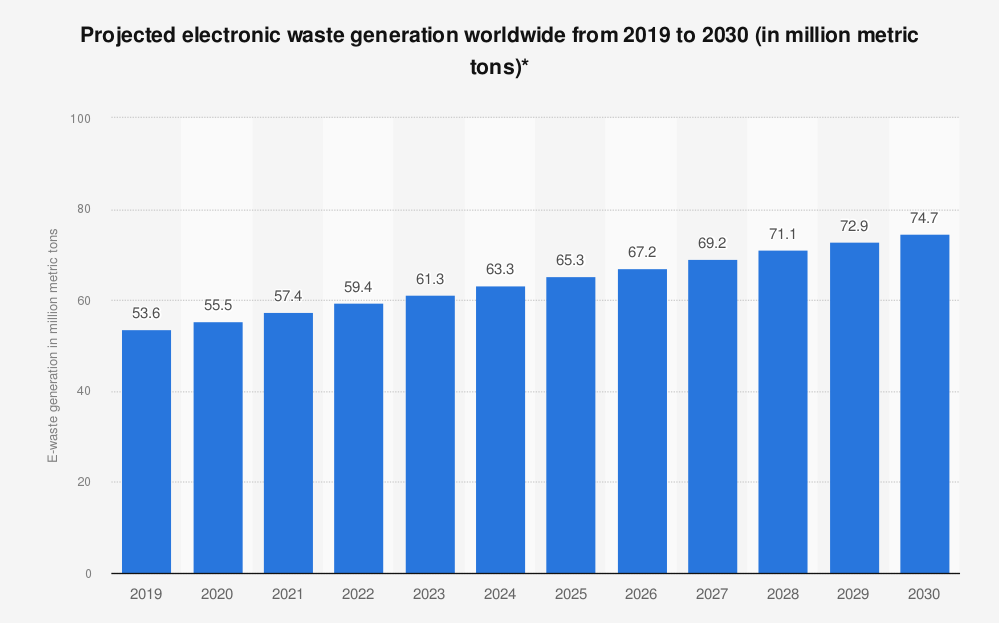
A 2020 study by the Global E-waste monitor* shows that refurbishing contributes significantly to reducing E-waste (electronic waste). It describes that 53.6 million tons of E-waste was produced worldwide in 2019, and is gradually increasing with a projection of 74.7 million tons in 2030. Of the 53.6 million tonnes of E-waste in 2019, only 17.4% was recycled. The rest is unfortunately incinerated or ended up in landfill, where it releases chemicals.
Energy saving
According to the U.S. Environmental Protection Agency (EPA), refurbishing a laptop can require up to 99% less energy than producing a new one. This high energy consumption mainly takes place when mining, transporting and refining raw materials. Because refurbished products already contain these materials largely intact, they hardly need to be added during the refurbishment process before a device is ready for sale.
Mining
The World Economic Forum reports that about 80 to 85% of the environmental impact of an electronic device is caused during the production phase, particularly when extracting raw materials. The devices we use every day require materials like gold, silver, silicon, lithium, and many more metals and rare earth elements, all of which must be extracted from the earth. Some of these materials are scarce, such as cobalt, of which it is estimated that there is only a stockpile until 2060.
CO2 emissions
The CO2 footprint of refurbished appliances can be lower than that of new appliances, especially if they are renovated and sold locally, as less transport is required. According to a study by the Fraunhofer Institute for Environmental, Safety and Energy Technology, buying refurbished laptops can cause up to 69% less CO2 emissions than buying new ones. The 17.4% recycled electronics in 2019 contributed to a saving of around 15 million tonnes of CO2. To get an idea of how much that is: On average, a petrol car emits about 2.3 kilograms of CO2 per liter. With 15 million tons of CO2, you could offset the emissions of about 6.5 billion liters of gasoline, which is equivalent to hundreds of billions of car kilometers.
*The Global E-waste Monitor 2020 is a collaborative product of the Global E-waste Statistics Partnership (GESP), formed by the UN University (UNU), the International Telecommunication Union (ITU) and the International Solid Waste Association (ISWA), in close collaboration with the UN-Environment Programme (UNEP). The World Health Organization (WHO) and the German Ministry of Economic Cooperation and Development (BMZ) also contributed substantially to the Global E-waste Monitor 2020 this year.